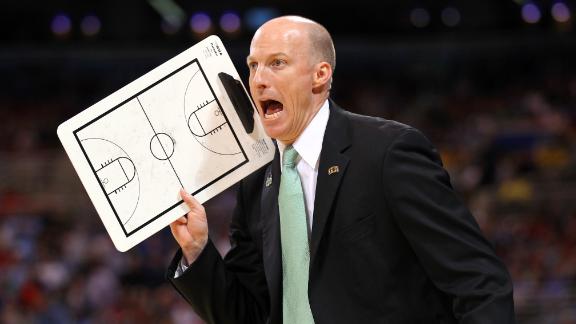
 Ok so I love the Ohio Bobcats more than anyone, but I'm pretty mad at the university, and John Groce in general. John Groce was paid $355,000 in salary and bonuses this season. According to the Athens Messenger Groce was also offered a raise that would have put him up to $500,000 annually. After Ohio's history making trek to the Sweet 16, Illinois offered Groce $1.2 million.
 I have no problem with paying coaches who make things happen, but the problem is that this more pay than any female faculty at the university makes. I'm not trying to get all feminist on here, (but I could) but these are the facts. Pam Benoit, the Vice President and Provost, is second in line at the university. Benoit is in charge of the university's finances and holds a key role in shaping the university's priorities. This makes her the second most influential person at Ohio University. Despite this her base salary is $250,000 per year with a $15,000 expense allowance. Added together she still receives about $90,000 less than John Groce and about $235,000 less than the university was reportedly offering Groce to keep him in Athens.
At a college that is facing a potential $5 million shortfall, and that is that is talking about raising tuition 3.5 percent in the next year, is it smart to spend that much more on a coach than a top administrator? I'm not talking about killing the athletic budget. I love going to a District I college that is eligible for bowl games, as well as March Madness, but I don't think that we can put the burden on students while athletics get's a free pass. 75 percent of the athletic budget comes from student fees. While students are paying more for tuition, the budget for athletics and their administration has also risen. And despite the money coming in, Ohio is still being sited for not being compliant with Title IX because of discrepancies in funding and facilities.
 I also have a problem with the university paying less to women employees than it does to men. According to the Provost's Women's Report, in the 2010-2011 school year, women were paid less at the university in every occupational type. This should not be acceptable to students or the administration. While many may argue that Title IX may be unfair to men's sports because football and basketball both bring more money into the school, no such case can be had when it comes to the salaries of school administration. The university paying women faculty members less than their male counterparts seems to be without reason. While John Groce's salary from Ohio University has been in headlines because of his recent depart, what is not being shown is how his pay is only a part of a larger problem at the university.

I enjoyed the insight from a student perspective on the exorbitant pay that Division 1 coaches receive, even at the Mid-Major level of colleges in NCAA's top classification. The reality is that most colleges subsidize their athletic departments, even at the highest level, and fewer than a couple dozen in Division 1 are able to cover their expenses without needing money from the general fund. Even Ohio State, which pulls down something like $120 million from athletic revenues, barely breaks even on an annual basis.
ReplyDeleteFor a school like Ohio University, holding onto a name coach is an expense, but from the administration's standpoint, the trickle down effect on the university as a whole is where they tend to rationalize the high dollar amount. For a school to have made a run to the Sweet 16, paying to keep the coach around for possibly more exciting tournament runs and victories in the future might draw a half million a year in additional ticket, merchandising, and advertising revenue for the school, not to mention the boost to enrollment interest. But, as you made a point of, the salaries tend to far exceed those of top administrators, to the point that you can argue whether it's worth the investment.
For a school like Ohio University, it's a far bigger risk to offer that kind of money to someone who is offering such an esoteric addition to the campus. Let's be honest - colleges can do just fine without spending wildly on coaches and the like. Marietta College, my alma mater up the road, is a Division 3 program with about as much overhead on athletics as a lemonade stand, and they have a powerhouse baseball program and had a D3 Sweet 16 team a couple seasons ago. The school has seen a bump in donations from the success, but they haven't broken the bank to keep the coaches around. I know D3 vs D1 is somewhat apples to oranges in terms of the finances, but the underlying principles are the same: College Athletics are a "value-added" product for the university experience, but the return on investment is relative, especially for a school in the position of Ohio University.